

Part 2 of 3
The Madrasa Ben Youssef
The Madrasa makes you look up before it lets you look around. The cedar eaves ringing the courtyard carry a band of carved Kufic script the full length of the wall, and somewhere in that stretch of calligraphy a gold sunburst is worked into a coffered ceiling, radiating out in a pattern hand-carved by someone who never intended it to be photographed on a phone. 
You don't design art like this. You accumulate it, one craftsman's decade at a time.
Bahia Palace
This is Marrakech's great, beautiful sprawl of a secret. Built in the late 19th century for Grand Vizier Si Moussa and his even more powerful son Ba Ahmed, it was designed to be the most magnificent palace of its time — and it still feels like it. You wander from sun-drenched courtyards paved in Carrara marble to shadowed riads dripping with intricate zellige tiles, carved cedar ceilings, and delicate stucco that took artisans years to complete.

The beautiful courtyard of Bahia Palace in Marrakesh, Morocco, with elegant architecture
It's not a museum of furniture — it's a museum of craft. Every doorway is a frame, every ceiling a story, every quiet fountain a moment to pause. Come early, let the tour groups pass, and stand for a minute alone in the Grand Courtyard. That's when you feel it: the hush of old power and extraordinary beauty, all built for one man's pleasure.

Stunning geometric and floral patterns on the ornate ceiling of Bahia Palace, Marrakesh, Morocco

There's no single vantage point that holds all of it at once. You have to walk the perimeter to actually see the building. A marble ablution basin sits ringed in wrought iron on a floor of green, blue, black, and ochre zellige, geometry laid over and over until the starts to feel less like decoration and more like a proof.
Le Jardin Secret
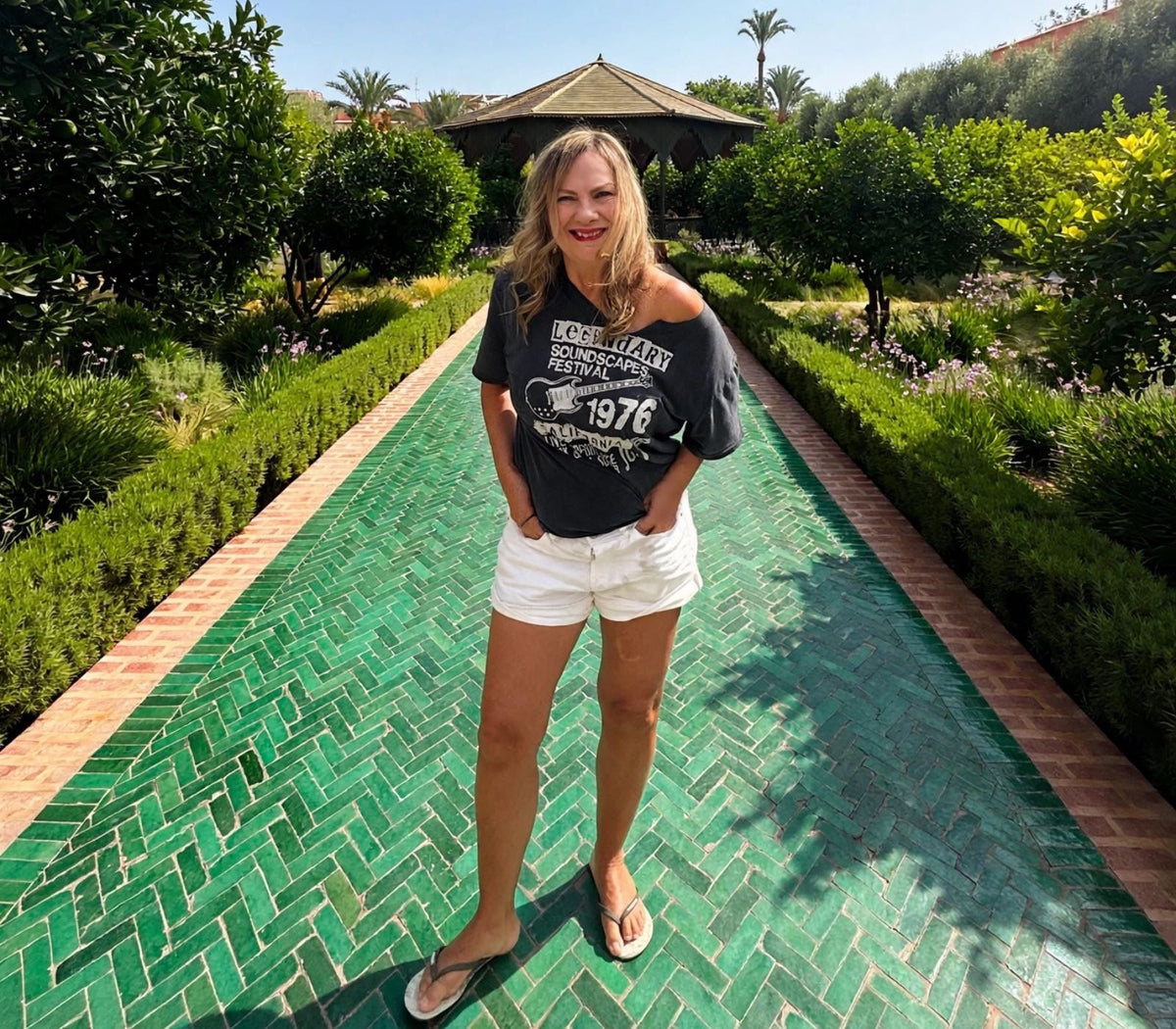
This medina oasis is the palate cleanser — a green herringbone-tiled path running dead straight through rows of orange trees, ending at a red cube of a building that has nothing ornate about it at all. After two palaces of carved stucco, the plainness of that red wall does more work than another arch would have.
Riad Dar Yammi
This twinkling sanctuary does its best work after dark. Pierced brass lanterns hang the full height of the courtyard, and the stucco panel above the fireplace is lit from behind so the star pattern glows rather than just sits there. The walls are pricked with tiny LED squares that read, from the room above, like a constellation someone mapped onto plaster. It's a small riad, but it borrows the same vocabulary as the grand houses — carved plaster, pierced metal, geometry lit to be noticed at night rather than just in daylight.
Jardin Majorelle
And then Majorelle, which is really a lesson in what one confident color choice does to everything around it. The cobalt isn't just on the walls — it's the ground the mustard-yellow panels and white stucco grilles get to argue with, and somehow nothing in that argument loses. Bamboo and palm close in overhead, a lily pond throws back a salmon-pink tower, and a cactus garden sits right up against a terracotta pot with a pomegranate ripening in it, like the desert and the citrus grove agreed to split the property down the middle.

Five buildings, seven days, and the thing that carried through all of it wasn't a single motif — it was the discipline. Every surface in this city seems to have been asked to do more than one job: structural and decorative, private and photographed, carved by hand and still standing centuries later.
Between the palaces and the souks, that's the trip in full,the buildings that shaped it, and the four pieces that came home because of it.


