Not every vintage piece deserves restoration, and knowing the difference early saves you time, money, and the heartbreak of falling in love with something that was never going to make it. Here's how we actually evaluate a piece before committing to bring it back.
"The question isn't whether a piece can be restored — almost anything can, with enough time and money. The real question is whether it should be."
Start with the bones, not the finish
A rough or damaged finish is almost never a reason to walk away — that's the easiest thing to fix. What actually determines whether a piece is worth saving is the structure underneath:
- Solid wood construction. Solid wood can be sanded, repaired, and refinished repeatedly. Veneer over particleboard or MDF has much less room for real restoration work before you hit the limits of the material itself.
- Joinery, not just hardware. Dovetailed drawers and mortise-and-tenon joints can usually be repaired or reinforced. Stapled or glued particleboard joints generally can't be meaningfully restored — once they fail, they fail for good.
- Structural squareness. A piece that's racked out of square (doors or drawers that no longer align) can sometimes be corrected, but it's a bigger job than most people expect — worth factoring into your decision, not just your budget.

Green flags — worth restoring
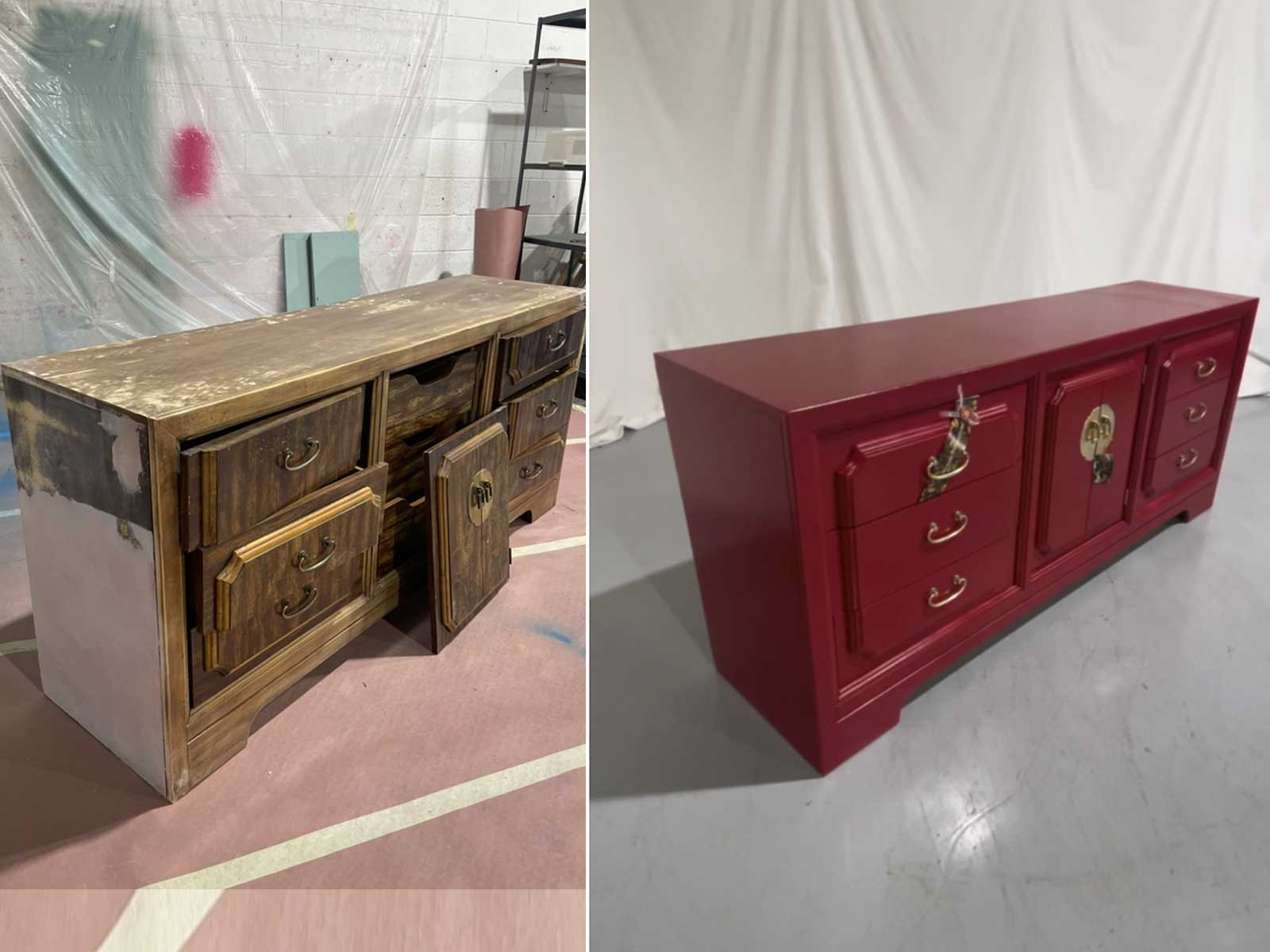
Cosmetic damage only. Scratches, water rings, faded finish, or an outdated paint color are all purely surface-level problems with straightforward fixes.
Isolated structural issues. A single loose joint, one damaged drawer, or a missing piece of hardware are all normal, expected restoration work — not red flags.
A maker or line you can identify. Recognizable quality construction (see our guide on spotting genuine Henredon or Drexel) is a strong signal the piece was well-built to begin with, which makes restoration effort worthwhile.
Red flags — consider walking away
Water damage that's reached the core. Surface water rings are fixable. Wood that's swollen, delaminated, or soft to the touch has often failed structurally, not just cosmetically.
Active insect damage. Powderpost beetle damage or active woodworm isn't just cosmetic — it's an ongoing structural problem that can spread to other pieces nearby if not properly treated first.
Extensive veneer loss on a veneered piece. Replacing large areas of missing veneer is possible but expensive and time-intensive — sometimes more than the finished piece will be worth.
A frame that's fundamentally out of square. If a case piece has racked so badly that doors and drawers can't be made to align without disassembling and rebuilding the frame, the labor cost often exceeds what makes sense for the piece.
A note for designers sourcing for clients
When evaluating a piece for a client project, it's worth separating "can this be restored" from "does this make financial sense to restore for this specific use." A piece with real structural issues might still be right for a client with a generous restoration budget and a strong emotional attachment to the piece — but it's a conversation worth having explicitly, rather than assuming.
Firebird Furniture evaluates every piece for restoration viability before sourcing it — solid construction first, cosmetic condition second.